This morning, the House Ways and Means Committee Subcommittee on Health will hold a hearing on the health care disparities created by Medicare in rural communities.This year, America’s hospitals celebrate the 50th anniversary of the Medicare and Medicaid programs. These two programs have had a significant impact on access to quality medical care, especially to the more than 60 million Americans who live in rural regions across the country. A disproportionate number of rural patients rely on Medicare or Medicaid and many, known as dual eligible patients, rely on both programs to meet their health care needs.
Given this scenario, rural communities face unique financial challenges and experience a more severe impact when Medicare and Medicaid funding is threatened. When support for these programs is cut, hospitals serving residents in rural areas struggle on many fronts, such as continuing to provide the scope of services needed in the community and, in some cases, to keep their doors open at all.
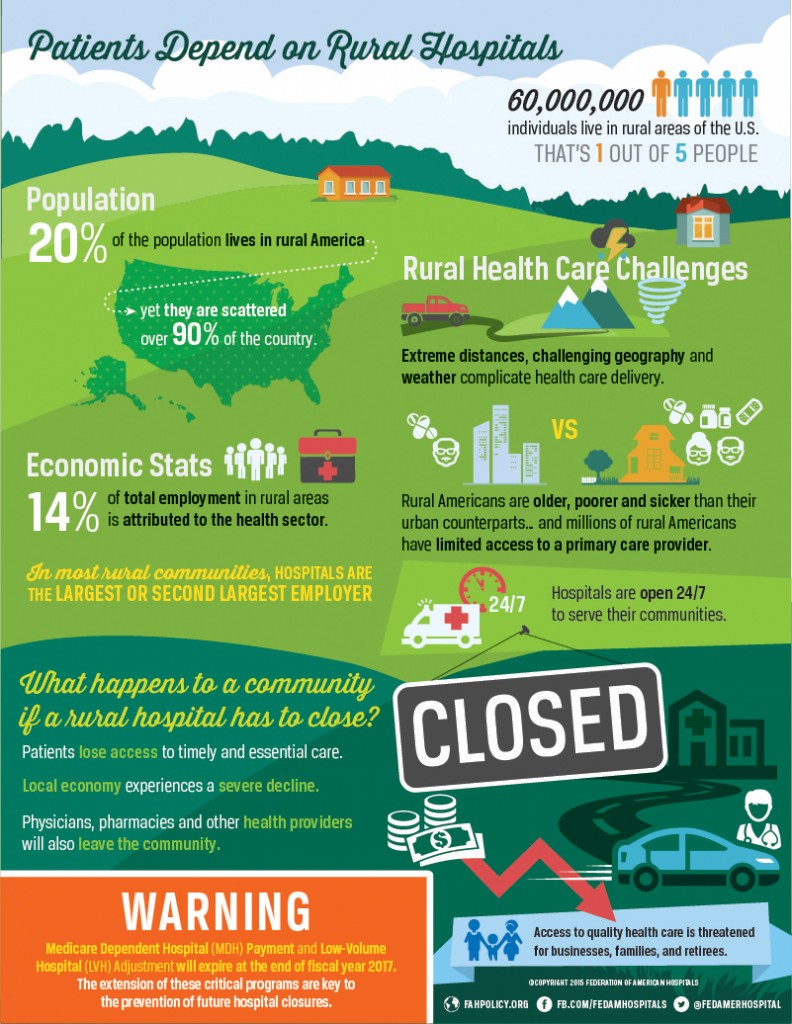
Hospitals are commonly the back bone of the rural communities in which these 60 million, or 1 out of 5, Americans live. Rural hospitals are a driver of the local economy providing jobs, a source of critical care for large geographic regions and a large employer for the many inputs fueling health care delivery. However, as Medicare and Medicaid are continually threatened with cuts and policy changes, these rural residents are put at considerable risk. Hospitals are seeing the lowest Medicare margin in history for 2015, project to be -9%. When rural hospitals are forced to reduce services or close, rural residents, especially the most vulnerable populations meant to be protected by Medicare and Medicaid, lose access to quality health care.
The FAH strongly supports the rural hospitals working through many challenges to provide access to critical care 24 hours a day for their patients. Hospitals are proud to serve as a pillar for all communities. The Medicare and Medicaid programs were established to protect seniors and low-income Americans. On this 50th year of the programs, FAH encourages lawmakers to reassess future threatening funding cuts and stand by the program as it was first established.