The release of a new study by FTI’s Center for Healthcare Economics and Policy last week brought to light a series of significant patient and community benefits from hospital realignment, challenging narrowly focused studies that utilize outdated information, leading to misperceptions about the impact of realignment.
Upon its release, several members of the media took note of its findings and impact on the common misconceptions surrounding realignment.
Health Leaders Media takes an in-depth look at the study and the ongoing dialogue about realignment between hospitals and insurers. The FAH commissioned the study by FTI; in an interview with Health Leaders Media Senior Editor John Commins, President & CEO Chip Kahn weighed in on insurers insistence of price increases in the face of new evidence with the FTI study release:
“AHIP is missing the point,” Kahn said. “You have to look at the big picture. All they are focusing on is simply their payment for the covered lives in their insurance book’s business. They are not really concerned, I don’t think, about the access of those people to hospital care,” he added.
If hospitals are going to be available for all Americans, then we have to be honest with ourselves that Medicaid and Medicare and maybe even the plans that are coming in under the new exchanges are not paying sufficiently and are putting pressures on hospital revenues to such an extent that consolidation and hospitals needing to right-size is where we are going.”
“The other side is if you go to the AHIP blog, most of the research that they base their conclusions on is old, based on data from the 1990s or the turn of the century. The environment then is not what the environment is today.”
Boston Globe reporter Robert Wiseman was the first to report on the FTI study, speaking with Kahn, who commissioned the study.
“When we’re looking at this trend toward consolidation, we have to look at the changing environment…. Only the larger institutions with integrated services can meet the tremendous accountability that’s required by hospitals today by Medicare, Medicaid, and private payers,” Kahn said. “We’re moving into a period where electronic medical records will not only be necessary, they’ll be mandated. That takes capital and concentration, and it takes larger institutions. The freestanding hospital is just going to have a hard time sustaining itself in that environment.”
In his piece on the study “Hospitals, Insurers Grapple Over ‘Consolidation’ Narrative,” John Reichard of CQ Healthbeat assesses the current set of opinions on hospital realignment, addressing the role of the FTC and Congressional legislation on Medicare as well.
In “3 Ways Hospital Realignment Can Help Hospitals”, Fierce Healthcare highlights the key benefits of enhanced access to care, greater efficiency and higher value of care based upon reinvestments in necessary technology and operations. The report acknowledges the more than $430 billion in hospital cuts that harm community hospitals the most. Without realignment, many smaller hospitals, especially Medicare dependent rural hospitals, would have to close their doors altogether. Hospital realignment is a means of survival, preventing delays and inefficiencies in care and emergency services as well as hospital closures.
The FTI study was also written up in Politico Pulse:
FAH STUDY: HOSPITAL MERGERS PRODUCE BENEFITS, NOT COSTS — A study commissioned by the Federation of American Hospitals and released Thursday concludes that hospital consolidations have actually benefited patients and communities — a finding the group says upends “conventional wisdom about the impact of consolidation. “This analysis is a reality check that turns the prevailing policy mantra about consolidation on its head,” said Chip Kahn, President and Chief Executive Officer of the Federation of American Hospitals. The study suggests no “consistent statistical relationship” between hospital consolidation and price increases. Previous studies have primarily indicated that a spate of hospital mergers and consolidations in recent years have driven up price and stifled competition. http://bit.ly/LZVWgO
Becker’s Hospital Review, Health Leaders Media and Asian Hospital and Healthcare Management are some of the other outlets covering this shift of focus on patient benefits, highlighting the stark difference this study presents from commonly held misconceptions in the health care industry, which are found to be rooted in data from the 1990s.
The study provided the most comprehensive review of contemporary mergers and realignments to date—canvassing 75 studies and 35 primary sources. And the findings serve as a much needed reality check after years of claims by insurers and others in the health care sector that never outlined the critical benefits such as: protected patient access to care, expanded service offerings and reinvestment in health IT and hospital facilities to best serve our patients.
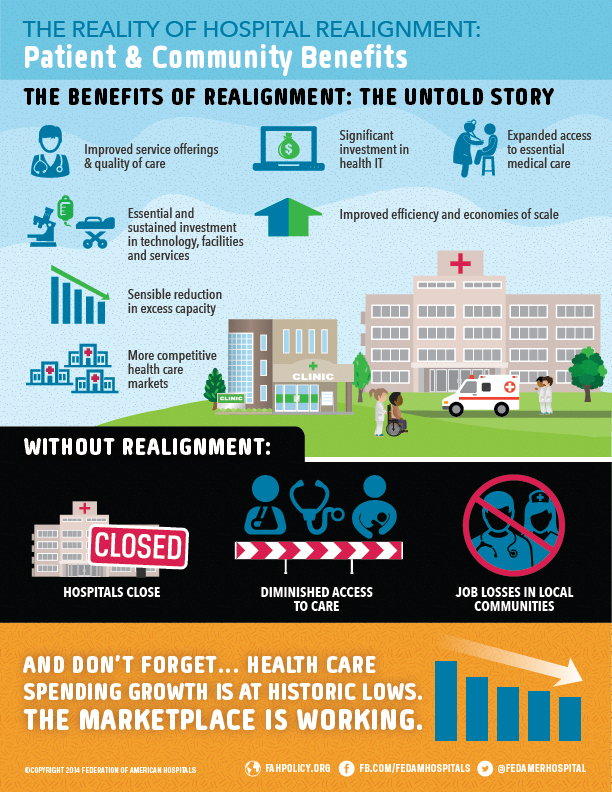
New technology and improvements in heath IT have the potential to bring America’s healthcare into an integrated and comprehensive system, but the initial capital necessary to invest in these new technologies can be overwhelming for small hospitals already struggling with mounting budget cuts.
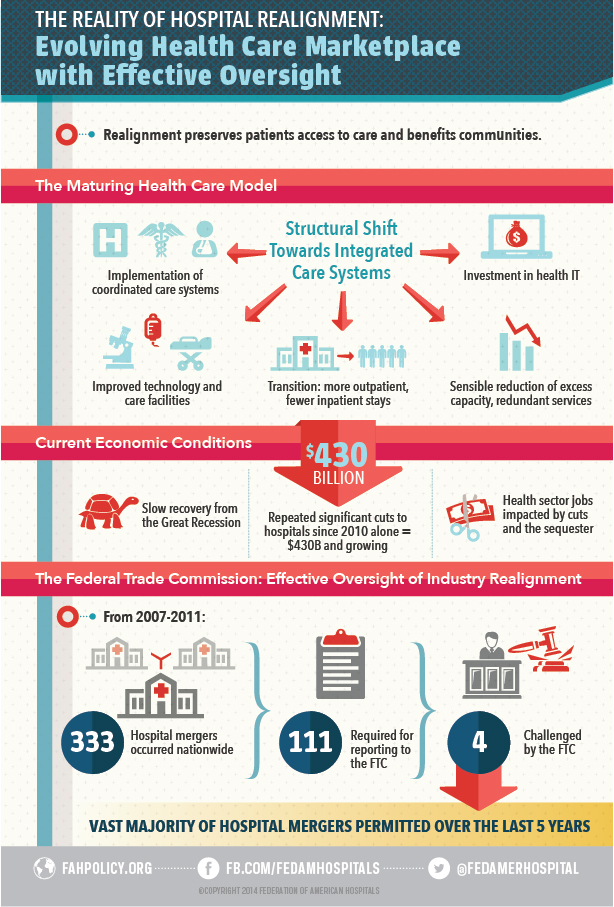
The new study highlights the substantial benefits that hospital realignment can have for hospitals and patients alike. Utilizing the most comprehensive and current data, instead of relying solely on outdated studies and old data from the 1990s, FTI’s study brings the reality of realignment to light.
The FAH is glad to see such a critical study receiving recognition from leading industry reporters, and welcomes the use of this report as the new standard in understanding what hospital realignment really means to patients across the country.